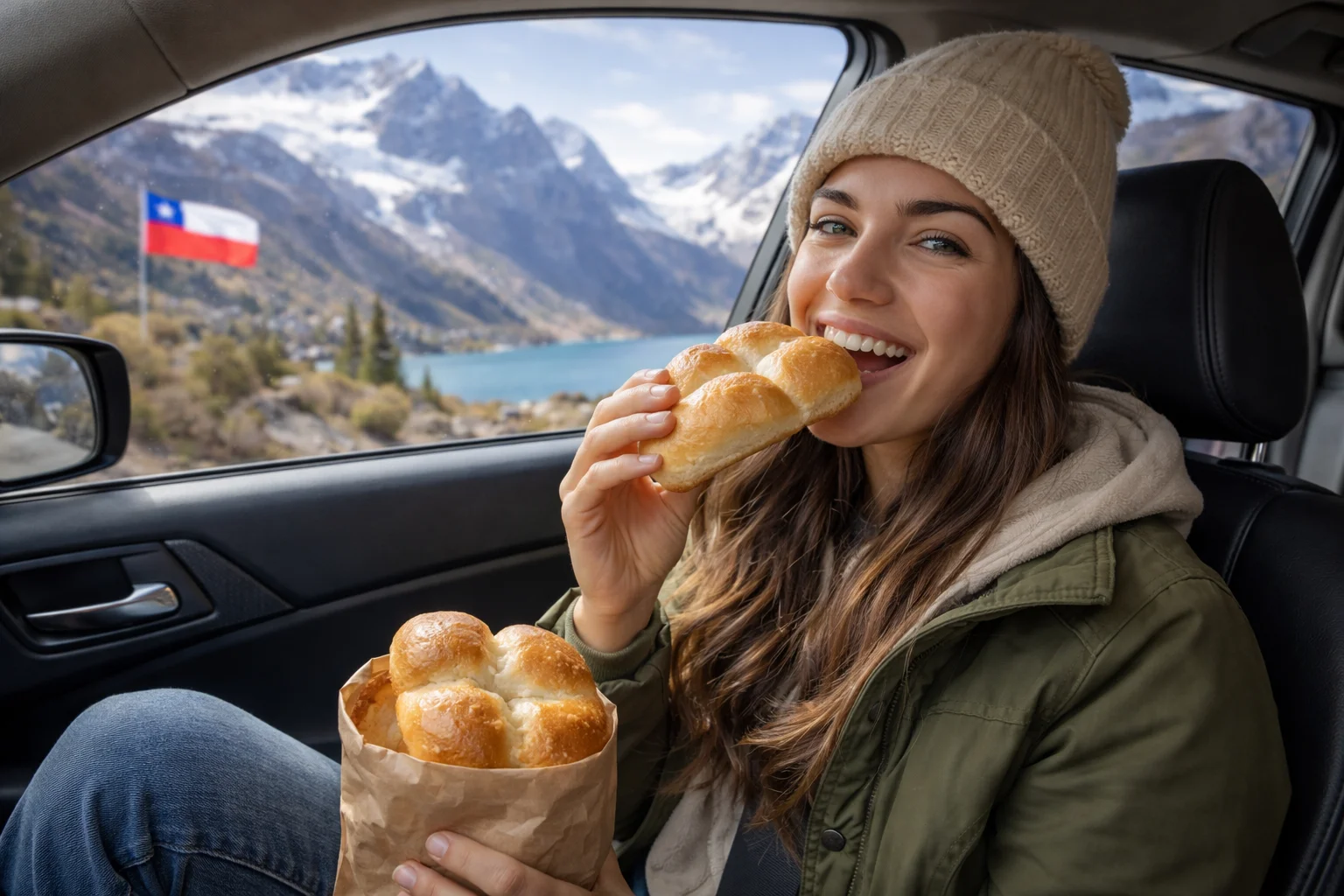
Chile is one of the countries with the highest bread consumption in the world, averaging around 90 kilos per person each year. Bread is much more than food in Chile—it is tradition, identity, and comfort. 90 kilos per person each year.
Below are some of the most popular and beloved varieties of Chilean bread, each with its own story and place in Chilean culture.
This is perhaps the most iconic Chilean bread. It is a crunchy, airy white bread, divided into four segments, making it easy to share. Traditionally eaten with butter, avocado (palta), or ham.
When travelling around Chile — whether in Santiago, along the coast near Valparaíso, or on longer road trips — one simple food appears everywhere: marraqueta. This golden, crunchy bread is considered by many to be the most characteristic bread in Chile, closely linked to daily routines and local food culture.
The exact origin of marraqueta is still debated, but two main historical explanations are commonly mentioned.
One widely accepted theory connects marraqueta to French immigrant bakers who arrived in Chile in the late 19th century, especially in the busy port city of Valparaíso. According to culinary tradition, two brothers with the surname Marraquette opened a bakery where they produced a light, crusty bread inspired by European baking methods.
The bread became popular among locals, and over time people began referring to it simply as "marraqueta."
Another theory suggests that a similar bread already existed in La Paz, Bolivia, where it also carries the same name. From there, the recipe may have spread south through trade routes and migration into northern Chile.
Regardless of its precise origins, marraqueta eventually became deeply rooted in Chilean food traditions and today is often seen as part of the country's culinary identity.
Chile ranks among the countries with the highest bread consumption per person in the world, and marraqueta plays a major role in that statistic.
It is eaten throughout the day — at breakfast with avocado or butter, as part of sandwiches during travel or work breaks, and especially during "once," the traditional late-afternoon meal shared with family or friends.
Stopping at a local bakery to buy fresh marraqueta is still a common habit in many neighbourhoods, offering visitors a simple way to experience everyday Chilean life.
For travellers exploring Chile by car, noticing foods like marraqueta — found in roadside bakeries, small towns, and city cafés — adds depth to the experience. It is a reminder that local culture is often discovered not only in famous destinations, but also in everyday traditions that accompany the road.
A round, flat bread with a soft, dense texture. Slightly greasier than marraqueta, it is commonly used for sandwiches and spreads. Hallullas are a staple in bakeries and homes across the country.
The word hallulla comes from Arabic "ḥallūla," referring to a type of flatbread. The concept travelled through Spain during the period of Arab influence and later reached Latin America during Spanish colonisation.
In Chile, the bread gradually evolved into its current form — a round, slightly dense white roll enriched with fat (traditionally lard or vegetable shortening). This adaptation gave hallulla a softer crumb and longer shelf life compared to crusty breads.
Today, hallulla is considered a traditional Chilean bakery staple, even though its deeper linguistic and culinary roots connect it to Mediterranean and Middle Eastern bread traditions.
Chile is among the countries with the highest bread consumption per capita, and hallulla plays a key role in everyday meals.
For this reason, hallulla is often chosen for sandwiches during workdays, travel stops, or family outings. It is also common at breakfast tables and during "once," the late-afternoon meal shared in many Chilean households.
Whether stopping at a roadside minimarket, a city bakery, or a coastal café, hallulla is one of those simple foods that quietly accompanies travel experiences in Chile — practical, filling, and deeply connected to local routines.
This bread is made by folding a round piece of dough into a triangle shape, creating layers inside. Soft and buttery, it's the Chilean cousin of a flatbread, often enjoyed warm.
Along with marraqueta and hallulla, dobladita is part of Chile's everyday bread culture. Simpler and more rustic in appearance, this folded flat bread is commonly found in local bakeries, street food stalls, rural towns, and traditional markets.
For travellers moving across Chile — especially outside large cities — dobladitas often appear as a quick and filling option during stops along the way.
The name "dobladita" comes from the Spanish verb doblar, meaning to fold, which describes its typical preparation. The dough is rolled flat and folded before cooking, giving the bread its recognisable shape.
Dobladitas are associated with traditional rural cooking in Chile, where simple breads were made using basic ingredients and cooked in wood-fired ovens, on metal plates, or sometimes fried in oil.
Unlike marraqueta or hallulla, dobladita does not have a clearly documented immigrant origin or specific historical introduction. Instead, it developed gradually as part of local culinary practice focused on practicality and affordability.
Chile has one of the highest bread consumption rates per capita in the world, and dobladitas contribute to this strong bread culture — especially outside formal bakery settings.
They are commonly eaten during informal meals, outdoor gatherings, and short food breaks while travelling between towns.
When exploring Chile by car, noticing foods like dobladitas — sold in small towns, roadside stands, or neighbourhood bakeries — offers insight into everyday local traditions. These small culinary details often become memorable parts of the travel experience.
Made by hand in rural areas and baked in wood-fired ovens. It has a rustic texture and rich flavor, often accompanied by pebre (Chilean salsa) or homemade jams.
A sweet, delicate bread, resembling a pastry with its unique striped design. It is often served at tea time with coffee or milk.
A square bread with a dense crumb and decorative designs on the surface. It is less common today but still appreciated in traditional bakeries.
A fried bread made with wheat flour and pumpkin (zapallo), giving it a golden color. Sopaipillas can be eaten savory (with pebre or mustard) or sweet (with chancaca syrup, called sopaipillas pasadas).
Among the most recognisable traditional foods in Chile is the sopaipilla — a round, fried dough widely sold in street stands, markets, neighbourhood bakeries, and roadside stops. Warm, simple, and filling, it is especially popular during colder or rainy days and forms part of everyday Chilean food culture.
For travellers moving across cities and rural areas, sopaipillas are often an easy and authentic snack to find while exploring.
Sopaipillas are not originally Chilean, but their roots go back to Spanish and Moorish culinary traditions. The name is believed to derive from the old Spanish word "sopaipa," referring to fried dough introduced to Spain during the period of Arab influence.
During colonisation, this cooking technique spread across Latin America. In Chile, the recipe gradually evolved into a distinct local version — particularly through the addition of zapallo (pumpkin) to the dough, which gives Chilean sopaipillas their characteristic colour and flavour.
Today, they are considered a traditional Chilean preparation, even though their deeper historical origins are Mediterranean.
Chile has a strong culture of simple, comforting foods, and sopaipillas perfectly fit this tradition.
They can be served in two main ways:
Because they are fried and filling, they are especially appreciated in cooler southern regions and during winter.
Trying sopaipillas during a journey through Chile offers a small but memorable connection to local everyday life — from busy Santiago corners to quiet roadside stalls in the countryside.
A traditional flatbread once cooked directly in hot ashes (rescoldo). Today, it's often grilled or baked, but it still carries the smoky flavor of its rustic origins.
Tortilla de rescoldo is one of the most rustic traditional breads in Chile. It is prepared by cooking simple dough directly in the hot embers ("rescoldo") of a fire, giving it a firm crust and slightly smoky flavour. This method developed in rural areas where ovens were not always available.
This bread reflects a combination of Indigenous cooking practices and Spanish wheat-bread traditions introduced during the colonial period. Over time, tortilla de rescoldo became closely associated with countryside life, outdoor work, and long journeys.
Although less common in cities today, it remains part of traditional rural food culture, especially in southern regions. It is usually eaten warm with pebre, butter, cheese, or manjar and is valued for being filling and practical for travel or outdoor meals.
A slightly sweet bread enriched with eggs, often shaped into small rolls. Popular at children's teatime or as a treat with butter and jam.
Pan de huevo is a traditional Chilean sweet bread especially associated with northern regions such as Antofagasta and Iquique. Small, round, and slightly sweet, it is commonly found in local bakeries, markets, and roadside food stops.
The bread developed as part of regional baking traditions in northern Chile, influenced by Spanish colonial pastry techniques and adapted to local tastes. Its name refers to the use of eggs in the dough, which gives it a richer flavour and a soft, golden texture.
Bread in Chile is not just food—it is a symbol of hospitality and daily life. Whether at a humble countryside table or a Santiago café, bread unites people across regions and generations. Each variety tells a story of migration, indigenous heritage, and adaptation to local ingredients.
"Bread is the thread that weaves together Chilean families, connecting past traditions with present moments of shared joy."
From the morning marraqueta with butter to the evening sopaipillas with chancaca, bread accompanies every important moment in Chilean life. It's not uncommon to see families gathering around bread, sharing stories. and creating memories that last a lifetime.
Rent a car and start your journey through these incredible destinations.
Browse Our Fleet